You searched for a tai chi chair workout you can print, follow at home, and keep next to your chair. Below is exactly that — a free 6-page PDF with 15 seated tai chi exercises across 3 color-coded routines (blue, pink, and purple), each with its own 30-day workout calendar. No email. No sign-up. Just click and print.
Tai Chi Chair Workout — 15 Exercises in 3 Routines + 30-Day Plans
A complete seated tai chi program you can print and stick on your fridge. Includes 3 color-coded routines (blue, pink, purple) with 5 illustrated exercises each, plus a 30-day calendar for every routine to track your progress.
- ✓ 15 gentle seated exercises across 3 routines
- ✓ Each routine has its own 30-day workout calendar
- ✓ Color-coded pages — easy to follow
- ✓ Large print with clear illustrations
- ✓ Each routine takes only 10–15 minutes a day
No email required. Instant download. Print as many copies as you like.
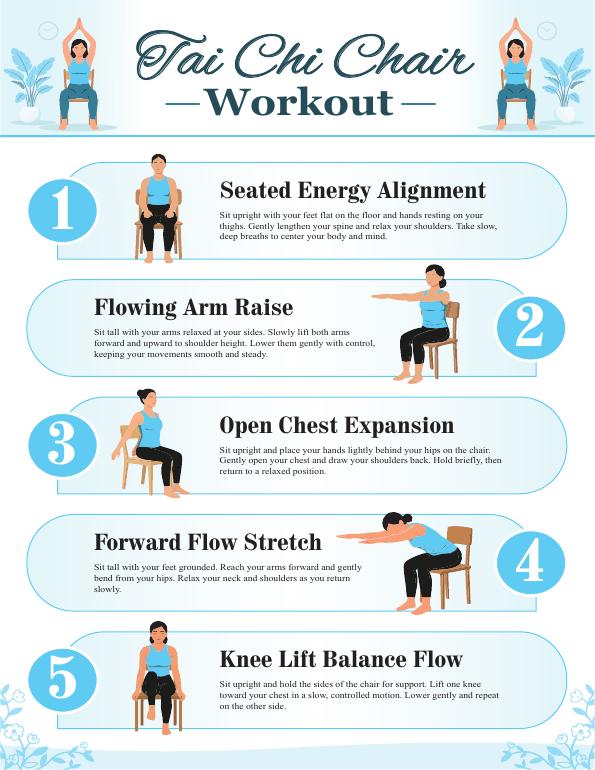
Why Tai Chi From a Chair Actually Works
Many people think tai chi only counts if you do it standing up. That is not true. The real power of tai chi is in the slow, smooth movements combined with deep breathing — and you can do all of that sitting down.
Researchers at Harvard Medical School found that tai chi improves balance, lowers blood pressure, and reduces the chance of falling by 35 to 45 percent in older adults. Chair-based tai chi gives you the same benefits because the movements, the breathing pattern, and the mind-body focus stay the same — the only thing that changes is your starting position.
Think of it this way: if you learn to sing sitting on a bench, your voice does not get worse when you stand up. You still practiced the breathing, the control, the rhythm. Chair tai chi works the same way — your body still learns the movements, and you build strength and balance even while seated.
This is exactly why physical therapists use seated tai chi in hospitals and rehab centers. It is not a watered-down version — it is the same practice, made accessible.
What Each Exercise Does for Your Body
The PDF contains 15 exercises across 3 color-coded routines. Each routine has 5 exercises and its own 30-day plan. Here is what every exercise does for you — the step-by-step instructions with illustrations are in the printable guide.
🔵 Blue Routine — Foundation & Posture
Start here. This routine teaches proper posture, opens your chest and shoulders, and builds the basics of seated tai chi. Perfect for your first 30 days.
1. Seated Energy Alignment
This is the starting position. It teaches your body to sit tall without straining. Good posture takes pressure off your lower back and helps you breathe deeper. Many seniors find that just this one habit — sitting properly with relaxed shoulders — reduces back pain over time.
Targets: posture, spinal alignment, breathing depth
2. Flowing Arm Raise
This opens up your shoulders and upper back. If you sit a lot — watching TV, reading, or working at a table — your shoulders slowly round forward. This exercise reverses that. It also wakes up the muscles around your shoulder blades, which helps you reach shelves and lift things more easily.
Targets: shoulder mobility, upper back strength, range of motion
3. Open Chest Expansion
Tight chest muscles pull your shoulders inward and make it harder to take a full breath. This move stretches the front of your chest and makes breathing feel easier. Deeper breaths bring more oxygen to your muscles and brain, which means more energy and better focus throughout the day.
Targets: chest flexibility, lung capacity, energy levels
4. Forward Flow Stretch
This gentle forward lean loosens your lower back and hips. Stiff hips are one of the biggest reasons seniors struggle to stand up from a chair. Doing this stretch daily helps keep that movement smooth and painless. It also calms your nervous system — slow forward stretches signal your body to relax.
Targets: hip flexibility, lower back relief, stress reduction
5. Knee Lift Balance Flow
This is the exercise that builds real balance. Lifting your knees while seated strengthens your hip flexors and core — the exact muscles that keep you steady on your feet. Falls happen when these muscles are too weak to catch you. This exercise trains them safely, without any risk of falling during practice.
Targets: core strength, hip flexors, fall prevention
🩷 Pink Routine — Mobility & Flexibility
Once you are comfortable with the blue routine, add this one. It focuses on side-to-side movement, shoulder freedom, and leg flexibility — areas that stiffen first as we age.
6. Seated Side Flow Reach
This sideways reaching movement stretches the muscles between your ribs and along the side of your torso. These muscles get tight from sitting in one position all day. Loosening them helps you twist to look behind you, reach across a table, and breathe more fully — your ribcage can actually expand further when these muscles are flexible.
Targets: side body flexibility, rib mobility, lateral balance
7. Shoulder Circle Release
Slow, controlled shoulder circles release the tension that builds up in your neck and upper back. If you carry stress in your shoulders — and most people do — this exercise helps reset those muscles. Done regularly, it reduces the stiffness that makes it hard to turn your head when driving or look up at a shelf.
Targets: shoulder tension release, neck mobility, upper back relaxation
8. Seated Arm Circle Flow
Full arm circles strengthen the muscles around your shoulder joint and increase your range of motion. This is especially useful if you have trouble lifting your arms above your head — for washing your hair, putting on a shirt, or reaching a cabinet. The flowing motion also improves coordination between your arms and breathing.
Targets: shoulder joint health, arm strength, upper body coordination
9. Controlled Leg Extension
Extending your legs from a seated position strengthens your quadriceps — the large muscles on the front of your thighs. Strong quads make standing up from a chair easier and protect your knees during walking. This is one of the most important exercises for preventing falls because these muscles are the first to weaken from sitting too much.
Targets: quadriceps strength, knee stability, standing power
10. Ankle Rotation Flow
Stiff ankles are a hidden cause of falls. When your ankles cannot adjust to uneven ground — a curb, a rug edge, a slightly uneven sidewalk — you lose your balance. This gentle rotation exercise keeps your ankle joints mobile and strengthens the small stabilizer muscles around them. It also improves circulation in your lower legs and feet.
Targets: ankle mobility, foot circulation, balance stability
🟣 Purple Routine — Balance & Calm
The most advanced routine. It adds spinal rotation, fine motor control, and a calming breathing exercise. Great for your third month or whenever you want a peaceful, focused session.
11. Seated Spinal Twist Flow
Gentle twisting movements keep your spine mobile and healthy. Your spine is meant to rotate — when it cannot, your whole body compensates and other joints take the strain. This exercise helps you look over your shoulder more easily, reach behind you, and maintain the natural flexibility that makes daily tasks feel effortless.
Targets: spinal mobility, core rotation, back health
12. Heel-Toe Balance Movement
This exercise trains the weight-shifting skill that keeps you balanced when walking. By pressing through your heels and then your toes while seated, you activate the calf muscles and foot muscles that stabilize every step you take. It is like practicing walking balance in a safe, seated position.
Targets: foot strength, calf activation, walking stability
13. Flowing Hand Wave
This flowing hand and wrist movement improves fine motor control and keeps your finger joints flexible. If you have stiffness in your hands from arthritis or from gripping things tightly, this exercise gently loosens those joints. It also trains your brain to coordinate small, precise movements — a skill that helps with writing, buttoning clothes, and handling utensils.
Targets: hand dexterity, wrist flexibility, fine motor coordination
14. Seated Knee Extension Hold
Holding your leg extended for a few seconds builds endurance in your thigh muscles — not just strength, but the ability to sustain effort. This is what helps you walk further without tiring, climb stairs without pausing, and stand in line without needing to sit down. The hold also strengthens the muscles that protect your knee joint.
Targets: leg endurance, knee joint protection, standing stamina
15. Calm Breathing Flow
This is the closing exercise for the entire program. It combines deep diaphragmatic breathing with slow, flowing arm movements. The purpose is to lower your heart rate, calm your mind, and end each session feeling peaceful and centered. Regular deep breathing practice lowers blood pressure, reduces anxiety, and improves sleep quality — benefits that last long after the exercise is over.
Targets: stress relief, blood pressure, sleep quality, mental calm
7 Proven Health Benefits of Chair Tai Chi
These are not just things that "might" help. Each benefit below is backed by medical research on tai chi for older adults.
1. Reduces Fall Risk by Up to 45%
Tai chi strengthens the small stabilizer muscles in your core and legs that keep you from losing your balance. A 2019 JAMA Internal Medicine study found tai chi cut falls in older adults almost in half.
2. Lowers Blood Pressure
The combination of slow movement, deep breathing, and mental calm helps your body lower stress hormones. Research in the Journal of Hypertension found tai chi can reduce systolic blood pressure by an average of 9 mmHg.
3. Eases Arthritis Pain
Gentle, flowing motion increases blood flow to your joints without stressing them. The Arthritis Foundation recommends tai chi specifically because it reduces stiffness and improves range of motion without impact.
4. Reduces Anxiety and Stress
Tai chi's breathing pattern activates your parasympathetic nervous system — the part that tells your body "you are safe." Regular practice lowers cortisol (the stress hormone) and improves sleep quality.
5. Improves Memory and Focus
Tai chi asks you to coordinate your movements, breathing, and attention at the same time. This "multi-tasking" trains your brain. Studies show tai chi practitioners score better on memory and cognitive function tests than those who do not exercise.
6. Strengthens Legs Without Standing
Knee lifts and controlled foot movements in seated tai chi work your thigh and calf muscles. Stronger legs make it easier to stand up from a chair, climb stairs, and walk steadily — all without putting your body at risk during the exercise itself.
7. Helps With Chronic Pain
Tai chi teaches your body to move smoothly instead of tensing up. This is important for chronic pain — tension makes pain worse. Slow, controlled movement breaks the tension-pain cycle and helps you move more freely over time.
Who This Workout Is For
This workout is for you if:
- You want to exercise but standing feels unsafe or tiring — every move is done sitting in a sturdy chair
- You have arthritis or joint pain — tai chi's slow, flowing movements are gentle on joints, no jumping or sudden twists
- You are new to exercise — the 30-day plan starts easy and builds up gradually, so your body adjusts at its own speed
- You want a calm way to start or end your day — the whole routine takes 10 to 15 minutes and leaves you feeling relaxed, not exhausted
- You are recovering from surgery or illness — seated exercises let you stay active while your body heals (check with your doctor first)
- You take care of a senior family member — print the guide for them to follow at home or in assisted living
- You are a physical therapist or caregiver — use the printable as a take-home routine for your patients or residents
How the 30-Day Plan Works
Each routine in the PDF comes with its own 30-day calendar. Here is the recommended path through all three:
Month 1 — Blue
Start with the blue routine
Build up from 2 exercises to all 5
~10–15 min/day
Month 2 — Pink
Add the pink routine
Do blue + pink, or alternate days
~15–20 min/day
Month 3 — Purple
Add the purple routine
Rotate or combine all three
~15–30 min/day
Check off each day on the calendar after you finish. Seeing those check marks add up is surprisingly motivating — it proves you are making progress, even on days when you do not feel like it.
Pro tip: Do your tai chi at the same time every day — right after your morning coffee or right before lunch. Tying it to an existing habit makes it stick. You do not need to do all three routines at once — even one routine a day, done consistently, gives real results. After 30 days with a routine, most people no longer need the calendar. It just becomes part of their day.
Chair Tai Chi vs. Standing Tai Chi — What Is the Difference?
| Chair Tai Chi | Standing Tai Chi | |
|---|---|---|
| Fall risk during practice | None — you stay seated | Low, but possible for beginners |
| Balance improvement | Yes — builds core and awareness | Yes — also trains leg muscles |
| Good for arthritis | Excellent — no weight on joints | Good — but knees bear your weight |
| Time needed | 10–15 minutes | 20–30 minutes typical |
| Equipment needed | A sturdy chair, that is all | Open floor space |
| Best for | Beginners, limited mobility, rehab | Active seniors, progression |
Chair tai chi is not "lesser" tai chi. It is the smart starting point. Many people begin with seated practice, build their confidence, and move to standing routines when they feel ready. Some stay with chair tai chi forever — and that is perfectly fine. The benefits are real either way.
What Happens After You Build Tai Chi Strength?
After a few weeks of chair tai chi — especially once you add the pink and purple routines — most people notice something: they feel more stable. Getting up from a chair feels easier. Walking to the kitchen feels steadier. That wobbly feeling when you turn around starts to fade.
That is the perfect time to add balance-specific exercises. Tai chi gives you the foundation — smooth movement, body awareness, breathing control. Balance training builds on top of that with exercises that directly target the muscles that keep you upright.
We created a separate guide for exactly this: 16 seated and standing balance exercises designed to work together with your tai chi practice. It is also free, also printable, and it picks up where the tai chi workout leaves off.
Balance Training for Seniors — 16 Exercises
The perfect next step after your tai chi routine. 16 balance exercises from seated to standing, with clear illustrations and safety tips. Pair it with your tai chi workout for a complete stability program.
- ✓ 16 exercises — heel raises, marching, seated rotations, and more
- ✓ Progresses from seated to standing exercises
- ✓ Works alongside your tai chi practice
- ✓ Print-friendly, large text
Also free. No email. Instant download.
Before You Start: Safety Tips
- Use a sturdy chair — a dining chair or kitchen chair works best. No wheels, no rocking, no armrests that block your movement. Place it on a flat, non-slippery surface.
- Wear comfortable clothes — nothing tight around your belly or chest. You need room to breathe deeply. Flat shoes or bare feet on a non-slip floor.
- Move slowly — tai chi is not a race. Imagine you are moving through warm water. If a movement hurts, make it smaller or skip it entirely.
- Breathe — breathe in when you lift, breathe out when you lower. Never hold your breath. If you catch yourself holding your breath, pause and reset.
- Stay hydrated — drink a glass of water before you start. Keep a glass nearby. Even gentle exercise works better when your body is hydrated.
- Talk to your doctor first if you have heart problems, recent surgery, dizziness, severe osteoporosis, or any condition that affects your movement.
Common Questions About Chair Tai Chi
Is chair tai chi safe for people with arthritis?
Yes. Tai chi is one of the most recommended exercises for arthritis because the movements are slow, smooth, and low-impact. There are no sudden twists or jumps. In chair tai chi, your joints do not carry your body weight, which makes it even gentler. The Arthritis Foundation recommends tai chi as a safe form of exercise for people with joint conditions.
How often should I do chair tai chi?
Every day is ideal, but 3 to 5 times a week is enough to see benefits. The key is consistency — doing it 4 times a week for a month beats doing it every day for one week and then stopping. Use the 30-day calendar in the PDF to build the habit.
Will chair tai chi actually improve my balance?
Yes. Studies show that tai chi reduces the risk of falling by 35 to 45 percent in older adults. Chair tai chi builds core strength, body awareness, and the habit of controlled movement — all things that improve balance. Many physical therapists start their patients with seated tai chi before progressing to standing exercises.
What is the difference between chair tai chi and chair yoga?
Chair yoga focuses on stretching and holding poses. Chair tai chi focuses on flowing, continuous movement. Both are great for seniors. Tai chi is better if you want to improve balance and coordination. Yoga is better if you want deeper stretches and flexibility. Many people do both — tai chi in the morning for energy, yoga in the evening for relaxation. We have a free chair yoga guide too if you want to try both.
Can I do tai chi in a wheelchair?
Yes, most of the exercises work from a wheelchair. The upper-body exercises in all three routines — including energy alignment, arm raises, chest expansion, shoulder circles, arm circles, spinal twists, and hand waves — can all be done without leg movement. Exercises that involve knee lifts, leg extensions, or ankle rotations may need to be modified depending on your mobility. Ask your physical therapist to help adjust those movements for you.
Is this real tai chi or just stretching?
It is real tai chi. Traditional tai chi uses slow, flowing movements synchronized with deep breathing. That is exactly what this workout does — just from a seated position. The arm patterns, breathing rhythm, and mind-body focus are authentic tai chi principles. The only adaptation is that your feet stay on the floor and your chair supports you.
How long until I see results?
Most people feel calmer and more relaxed after the very first session. Physical changes like better balance, easier breathing, and less stiffness typically show up after 2 to 3 weeks of regular practice. The 30-day plan is designed to get you to that point gradually.
Can I do this alongside my physical therapy?
Usually yes, but check with your physical therapist first. Chair tai chi is gentle enough that most therapists welcome it as a complement to their program. Some therapists actively use tai chi as part of their fall-prevention and balance-training protocols.
How long does a chair tai chi session take?
Each routine has 5 exercises and takes about 10 to 15 minutes. You can do one routine per day or combine them as you get stronger. Beginners should start with the blue routine and build up over 4 weeks using its 30-day calendar. Even a 10-minute session with one routine is worthwhile — short and consistent beats long and occasional.
Can tai chi lower blood pressure?
Research suggests yes. A review published in the Journal of Hypertension found tai chi can lower systolic blood pressure by an average of 9 mmHg. The combination of slow movement, deep breathing, and relaxation helps the body reduce stress hormones that raise blood pressure. It is not a replacement for medication, but it can be a helpful addition to your treatment plan.
Is chair tai chi good for seniors with dementia?
Yes, chair tai chi can benefit people with mild to moderate dementia. The repetitive, calming movements reduce agitation, and the mind-body focus helps improve short-term attention and mood. Caregivers can guide the exercises step-by-step using the printable PDF. The large print and simple illustrations make it easier to follow.
What type of chair should I use?
Use a sturdy chair with a flat seat and a straight back — a standard dining chair or kitchen chair works perfectly. Avoid office chairs with wheels (they can roll), rocking chairs (they move), and deep armchairs or couches (too soft, too low). Your feet should rest flat on the floor when seated. If your feet do not touch the floor, place a folded towel or book under them.
Can I do chair tai chi after knee or hip replacement?
In most cases yes, once your surgeon clears you for gentle exercise — typically 6 to 8 weeks after surgery. Chair tai chi is actually one of the safest ways to ease back into movement. Start with the upper-body exercises from the blue routine (seated energy alignment, arm raise, chest expansion) and skip any knee lifts or leg extensions until your surgeon says you are ready. Always follow your surgeon's specific guidelines for your recovery.
More Free Guides You Might Like
Chair Yoga Exercises for Seniors
Gentle stretches and poses from a chair. Great paired with tai chi for a complete morning routine.
Download Free → Download PageTai Chi Chair Workout — Download Page
Quick download page with the PDF and a preview of what is inside.
View Guide → Back PainChair Exercises for Lower Back Pain
Targeted stretches to loosen your lower back without standing up.
Download Free →Medical disclaimer: This guide is for general wellness information only and is not medical advice. Always talk to your doctor before starting a new exercise program, especially if you have heart disease, recent surgery, chronic pain, or balance problems. Stop any exercise that causes pain or dizziness.
Written by Walid Hasan · Last updated October 31, 2026
📥 Get the Free Printable Guide
Download the complete Tai Chi Chair Workout for Seniors: Free Printable PDF (15 Exercises + 30-Day Plan) as a free printable PDF — print it out and keep it handy.
⬇ Download Free PDF